Table of contents
In many countries, citizenship ceremonies have quietly shifted online since the pandemic, and while video calls kept systems moving, they also thinned out something harder to measure: the public weight of becoming a citizen. Governments from Canada to Australia have since urged a return to in-person ceremonies, pointing to higher satisfaction, fewer technical failures and a renewed sense of civic moment. Behind the administrative detail sits a bigger question: what do societies lose when citizenship becomes just another digital transaction?
When the oath feels like more than paperwork
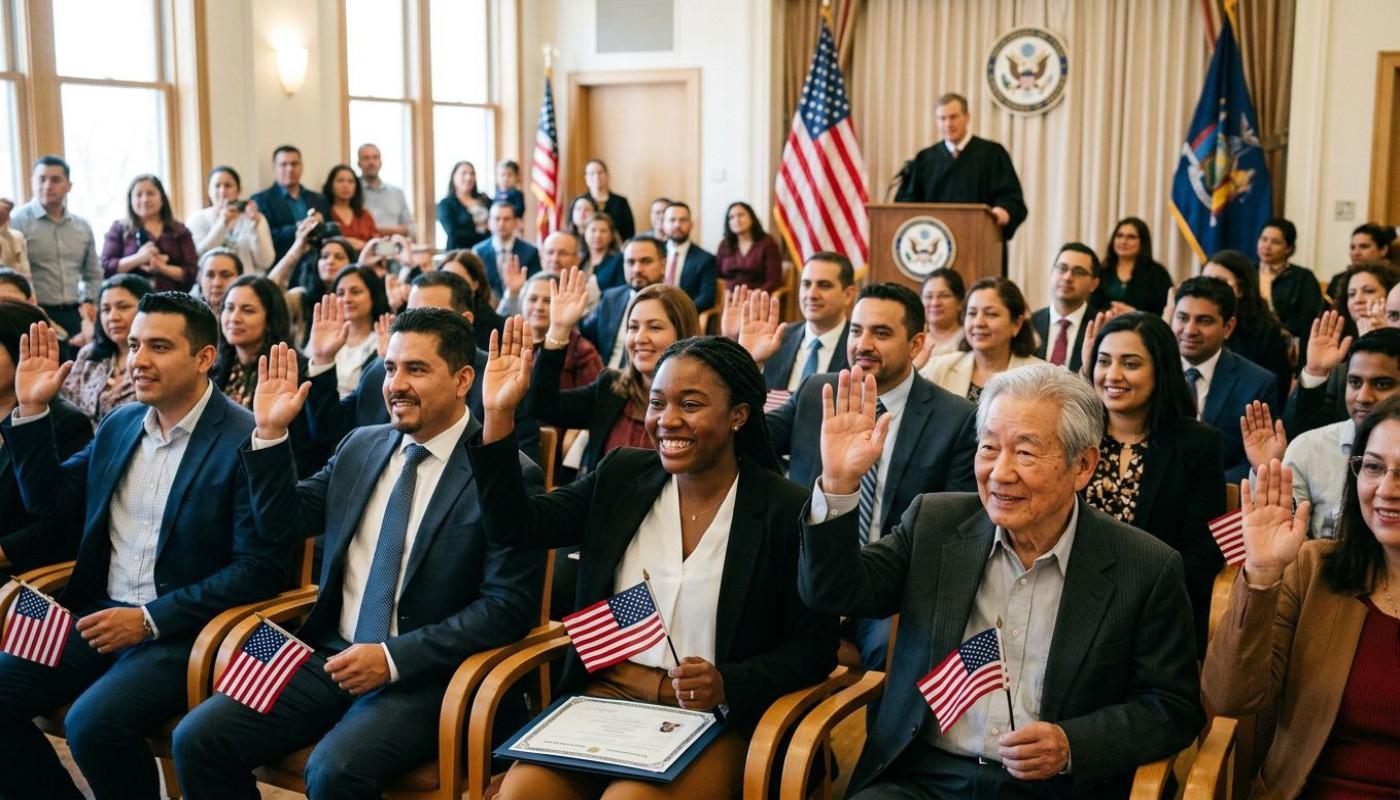
Ask new citizens what they remember, and it is rarely the PDF certificate. It is the room, the flags, the judge or registrar speaking directly to them, the moment of standing up together and repeating words that are, in practice, the legal hinge between residency and full political membership. Scholars of civic ritual have long argued that ceremonies do not merely “celebrate” status, they help produce it, because the state is seen, heard and embodied, and the individual is publicly recognised; that is why many countries have formalised the oath as a mandatory step rather than a symbolic extra.
The pandemic disrupted that logic almost overnight. In Canada, Immigration, Refugees and Citizenship Canada began holding virtual ceremonies in 2020, allowing tens of thousands to complete the final step despite restrictions, and by 2021 the department reported that most ceremonies were still happening online. Australia similarly expanded online pledges during Covid-19, then, as restrictions eased, encouraged councils to restore face-to-face events. The case for virtual access is strong, particularly for remote communities, people with disabilities, parents of young children and applicants juggling shift work; yet the trade-off shows up in the texture of the experience. A choppy connection, a muted microphone or a distracted household can make a once-in-a-lifetime transition feel like a compliance task.
There is also a governance dimension that is easy to miss. In-person ceremonies create a clear, controlled environment for identity verification and oath administration, and they allow officials to observe whether a participant understands what is happening, or needs support. Remote ceremonies can work well with strong protocols, but they rely on stable connectivity, secure digital identity processes and, often, the participant’s tech literacy. The result is a paradox: digitisation can widen access, and still deepen inequality when the “last mile” depends on the quality of someone’s internet, device and private space.
None of this means digital ceremonies should be scrapped. It means the in-person option carries a value beyond nostalgia, because it anchors citizenship in public life, and that anchoring can shape how new citizens see their role, and how communities see newcomers. Voting, jury service and eligibility for certain public jobs are legal consequences; belonging is the social one, and ceremonies are one of the rare moments when the two meet in the same room.
Local halls, national stories: why place matters
A citizenship ceremony is often the most direct encounter a person has with the state that is not mediated by forms, call centres or immigration interviews. When it happens in a town hall, a community centre or a courthouse, it also says something about where civic life lives: not only in capitals, but in neighbourhoods. That is why municipalities and local representatives frequently play a role, and why many countries deliberately stage these events as community occasions, with speeches, anthems and, in some places, local welcomes or acknowledgements of Indigenous custodianship.
The setting affects who shows up and how. In-person events make it easier for families to attend, and for civic organisations to offer support, from newcomer associations to language programmes. They can also act as a soft bridge into local participation, because the people sharing the room are often the same people who run voter registration tables, volunteer groups and community services. When ceremonies are held online, that civic ecosystem is harder to activate, and the new citizen’s “first day” can pass without any meaningful link to the place they actually live.
Data on outcomes is still emerging, but governments have repeatedly highlighted demand for the in-person experience once it returned. In Canada, IRCC has described a gradual reintroduction of in-person ceremonies while maintaining virtual capacity, and in Australia the federal government has encouraged councils to increase ceremony availability after pandemic backlogs, precisely because face-to-face events can process larger groups efficiently and reduce the risk of last-minute technical failures. Efficiency matters for applicants too: missed ceremonies, whether due to a dropped connection or an administrative reschedule, can delay passport applications, travel plans and job onboarding.
Place also matters for legitimacy. Citizenship is, by definition, political membership, and the ritual of receiving it in a public venue communicates that membership is granted by law and witnessed by the community. That public witnessing can be particularly important at a time when migration debates are polarised, and when misinformation about rights and eligibility circulates easily online. A well-run in-person ceremony, calm and dignified, can quietly counter a lot of noise, because it shows the process is structured, accountable and real.
The digital shortcut that can widen inequality
Virtual ceremonies are often sold as modernisation, and modernisation can be good. Yet anyone who has tried to join a high-stakes video call on unreliable Wi‑Fi knows how quickly “convenient” can become stressful. The digital divide is not abstract: in the United Kingdom, the Office for National Statistics has repeatedly documented that internet access and digital skills remain uneven by age, income and disability status; in the United States, the FCC has long tracked gaps in broadband availability; in many small island states and developing economies, connectivity can be expensive and intermittent. When citizenship’s final step depends on that infrastructure, the state effectively offloads part of its administrative burden onto the applicant.
There are privacy and security considerations too. Remote oath-taking can require applicants to show identity documents on camera and to share personal information in a domestic setting, sometimes in crowded housing. That is not trivial for people who have experienced persecution, or for those living in precarious conditions. In-person ceremonies, by contrast, provide controlled environments and professional handling of documents. They also reduce the risk of impersonation, not because fraud is rampant, but because systems should be designed for integrity, and the public expects citizenship procedures to be robust.
At the same time, the world of citizenship is broader than a single country’s naturalisation queue. A growing number of people now look at citizenship strategically, weighing mobility, safety and opportunity in a way that would have seemed niche two decades ago. That market has expanded, and it has also become more scrutinised, as the European Union and national governments tighten due diligence and transparency expectations around investment-linked pathways. In that landscape, clarity about process and authority matters, and readers who are researching programmes, timelines and legal steps often start by checking an official website, not to chase hype, but to verify what is actually offered, what documents are required and what government channels are involved.
Whether a person is naturalising after years of residence, or exploring another jurisdiction’s legal pathways, the same principle applies: citizenship is not just a status update, it is a change in rights and obligations that should be administered with seriousness. Digital tools can help, but they should not turn one of the most consequential acts a state performs into a low-trust, low-ceremony transaction.
Ritual is not fluff: it is public trust
It is tempting to dismiss ceremony as theatre. Yet democratic systems rely on moments that signal continuity and shared rules, and citizenship ceremonies do that work quietly, without partisan banners and without policy fights. They provide a scripted, lawful moment that says: these are the terms of membership, these are the values the state claims to uphold, and this person now belongs to the political community. That signalling is not cosmetic; it is part of how institutions cultivate trust, especially among people who may have experienced the opposite in their country of origin.
There is a practical upside as well. In-person ceremonies can be paired with immediate services, from voter registration information to passport guidance and local settlement resources. They can also reduce confusion about next steps, which is a real source of administrative friction. Applicants often need to know how soon they can apply for a passport, how to update employers, how to sponsor family members, or what happens if travel is planned; a short briefing at the ceremony, plus printed guidance, can prevent a cascade of calls and emails later.
Governments, for their part, have incentives to keep both models. Virtual ceremonies can clear backlogs and serve remote applicants; in-person ceremonies can deliver a higher-quality civic experience and a stronger assurance environment. The question is not digital versus physical, it is what is lost when physical options disappear, and how to design systems that do not force applicants to trade dignity for convenience.
In an era when so much of public life is mediated through screens, in-person citizenship ceremonies offer something increasingly rare: a shared, lawful moment that is not primarily transactional. For many new citizens, it is the day the state stops being a file number, and becomes a community they can see, hear and join.
Booking, costs and support: what to check
Applicants should confirm ceremony formats early, because in-person slots can fill quickly and virtual attendance may require device checks and identity steps. Budget for fees, travel and document translations, and ask about accommodations for disability or caring responsibilities. Some countries and municipalities offer settlement support or fee assistance; check eligibility, timelines and required proof before you book.
On the same subject

How International Banking Reveals The Best Places To Incorporate
